
Information to help you understand your condition and discuss your care with your eye specialist.
What is a Cataract?
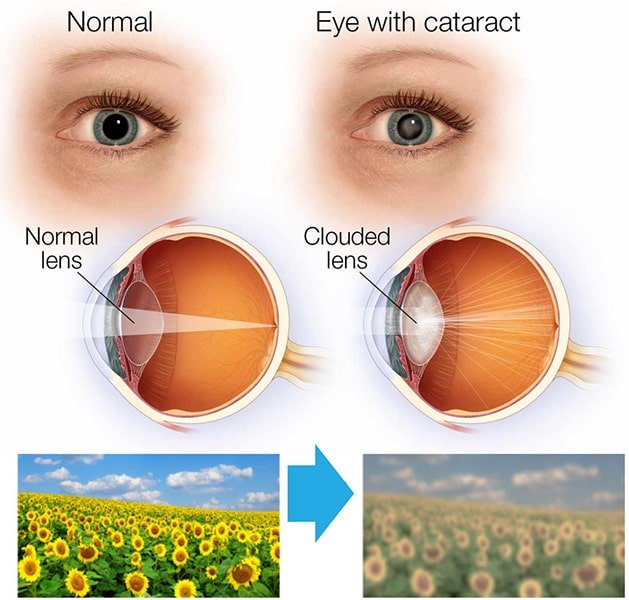
A cataract is a clouding of the natural lens inside your eye. This lens helps focus light so you can see clearly. As the lens becomes cloudy, it causes vision to become blurry, dim and not as clear as it once was.
Common symptoms include:
- Blurry or cloudy vision
- Glare or halos around lights
- Colours appearing faded or yellowed
- Trouble seeing at night
- Frequent changes in glasses prescription
What is Cataract Surgery?
Cataract surgery removes the cloudy lens and replaces it with a clear artificial lens called an intraocular lens (IOL). It is a common operation performed through very small incisions that do not typically require sutures.
Goals of Surgery:
- Improve clarity of vision
- Enhance day-to-day quality of life
- Reduce symptoms of cataract (e.g. glare)
Risks and Benefits:
Benefits:
- Improved clarity of vision. The result depends on the health of your eye and any other eye conditions.
- Enhanced day-to-day quality of life
- Reduced symptoms of cataract (e.g. glare, reduced contrast)
- Reduced dependence on glasses
Possible risks
- Infection
- Prolonged inflammation
- Retinal detachment
- Need for further surgery
Lens and focusing options
Intraocular lens (IOL) options:
| Lens or focusing option | Description | Best For |
|---|---|---|
| Monofocal | Corrects vision at one distance (usually far) | This is the most common lens strategy used. It is for patients who want to maintain the best possible clarity of vision at one focal distance and are happy to wear glasses as needed for other focal distances (e.g. far vision without glasses, near vision with reading glasses) |
| Monovision | One eye for distance vision, one for near vision | Suitable patients who want to minimise dependence on glasses whilst maintaining the best possible clarity |
| Extended depth of focus (EDOF) | Extended range of focus for intermediate + distance vision | Suitable patients who want to reduce the dependence on glasses but are happy to use them occasionally for near vision |
| Multifocal | Multiple focus zones for distance, intermediate and near | Suitable patients with healthy eyes who are motivated to minimise dependence on glasses |
*The best lens choice depends on the health of your eyes and your lifestyle. We will discuss the best option for you during your consultation.
Will I still need glasses after surgery?
The need for glasses depends on your lens and focusing options. Many people are less dependent on glasses afterwards, but still benefit from them for some activities, particularly fine or small print.
What to expect for the surgery?
- Operating time: usually 10–15 minutes. Your total time at the hospital will be longer.
- Location: Day surgery hospital, you will go home the same day as the surgery
- Anaesthesia: Local anaesthetic with sedation by an anaesthetist
- Recovery: vision often improves over the following days, but the speed and extent of recovery vary.
- Aftercare: use your prescribed eye drops as directed, commonly for around four weeks. Your surgeon will confirm your own schedule.
Any questions?
We’re here to help. Please bring up any questions or concerns at your appointment.
Planning your recovery
Arrange for someone to take you home and stay with you after surgery. Follow your surgeon’s instructions about your protective eye shield, eye drops and follow-up visits. Other eye conditions may limit the improvement in vision. Additional risks can include bleeding, pressure changes and swelling at the macula; your surgeon will explain your individual risks.
Illustrations
Questions or concerns?
For advice about your own eyes, contact South Street Eye Clinic on (08) 9312 6033 or Mount Lawley Eye Clinic on (08) 9371 1910. Seek urgent eye assessment for sudden vision loss, a new curtain or shadow, or severe eye pain. If urgent help is needed outside clinic hours, attend your nearest emergency department.